When a fire occurs during renovation in a high-rise building in Hong Kong, homeowners face a complicated web of insurance policies, exclusions, contractor obligations, and legal rights. Unlike ordinary fire incidents, renovation-related fires often trigger special rules because construction work increases risk and insurers treat this risk differently.
This guide explains how homeowners can recover losses depending on the type of damage and the insurance/contractual framework in place.
1. Identify the type of loss
Homeowners may suffer several types of losses after a renovation-related fire. The recovery depends on the source of the loss (damage to the unit, common parts, personal property, or personal injury) and the insurance/contractual framework in place.
(a) For Damage to common parts (structure, external walls, stairwells):
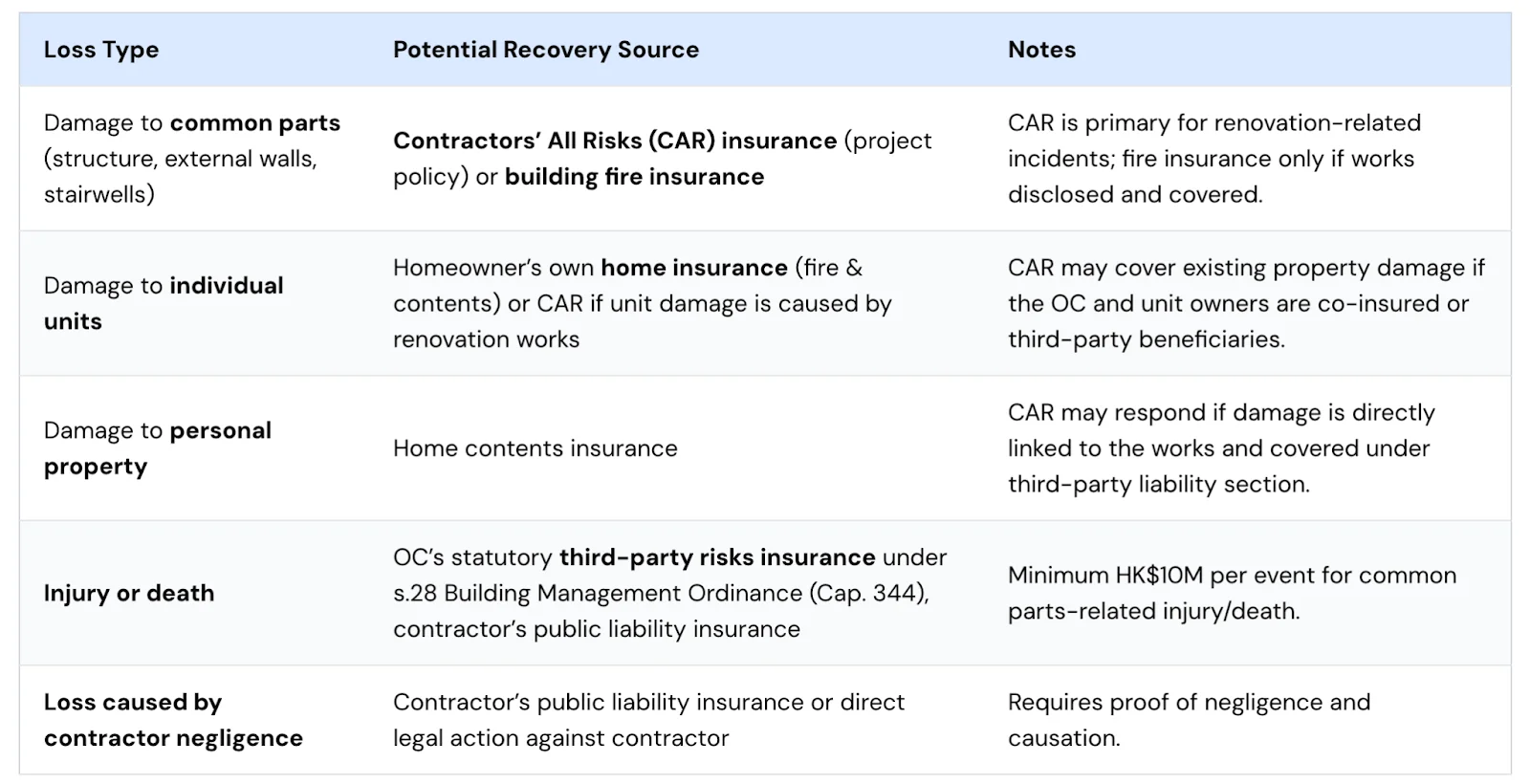
Potential Recovery Source: Contractors’ All Risks (CAR) Insurance is the primary policy which is applicable. Building Fire Insurance (OC policy) is secondary.
How it works: Renovation work in Hong Kong buildings almost always requires the contractor to maintain a CAR insurance policy. CAR policy may cover both:
- the renovation works, and
- the existing building structure
If a fire originates from renovation works (e.g., welding sparks, electrical overloading, improper hot works), CAR is the first policy to respond.
The building’s fire insurance may cover structural damage only if:
- the Owners’ Corporation (OC) notified the insurer of renovation; and
- the policy was extended to cover renovation risks
(b) For Damage to Individual Units
Potential Recovery Source: Homeowner’s home insurance (fire or home contents) and CAR insurance (if the fire is linked to renovation works)
How It Works: A unit owner’s own home insurance typically covers internal fixtures, decorations, built-ins, and structure within their unit boundary. However, many policies exclude construction-related incidents unless declared.
If unit damage is connected to renovation works, for example the fire spread due to contractor’s activities, electrical sparks during rewiring etc, then the CAR policy may cover the loss, especially if:
- the OC and unit owners were named as co-insured; or
- the policy includes “Damage to Existing Property” coverage
Not all CAR policies automatically cover existing units and the owners should verify coverage early.
(c) For Damage to Personal Property (Furniture, Electronics, Clothing, Valuables)
Potential Recovery Source: Home insurance (primary) and CAR third-party liability coverage (in limited cases)
How It Works: Personal belongings are not covered under building fire insurance or OC policies. Home contents insurance is the main source of recovery for items inside a unit.
CAR insurance may only compensate for personal property if:
- the fire was caused by renovation works; and
- the damaged contents qualify as “third-party property”
However, CAR policies often impose strict limits for third-party personal property, so the homeowner’s own contents insurance is usually the safest route.
(d) For Injury or Death
Potential Recovery: OC’s statutory third-party risks insurance (Cap. 344) and/or Contractor’s public liability insurance
How It Works: Under the Building Management Ordinance (Cap. 344), OCs must maintain third-party risks insurance covering injury or death occurring in the common parts.
If the fire injures residents, workers, visitors, members of the public then two policies apply:
- OC’s third-party risks insurance which covers injuries in common areas (lobbies, car parks, corridors).
- Contractor’s public liability insurance which covers injuries caused by the contractor’s negligence or activities.
It is important to note that neither covers structural damage but only bodily injury or death.
(e) Loss Caused by Contractor Negligence
Potential Recovery: Contractor’s public liability insurance and/or Direct legal action in tort (negligence)
How It Works: If the contractor’s actions directly caused the fire, for example unlicensed hot works, improper electrical installations, failure to follow safety protocols etc then homeowners may sue the contractor for property damage, consequential loss, alternative accommodation expenses, loss of rent. To succeed, the homeowner must prove negligence and causation.
It is important to note that Public liability insurance may cover the contractor’s liability, but only for third-party claims (not their own works).
Here’s a summary of the main types of losses in a building renovation related fire and the possible insurance sources for recovering those losses:
2. Key Facts
Renovation is a material fact that affects insurance coverage. Hence, it is important to know the following key facts”
- Building fire insurance may exclude damage caused by renovation unless the insurer was notified and endorsed the policy.
- CAR insurance is designed to cover construction-phase risks; the OC should ensure it names the OC and possibly unit owners as co-insured.
- Home insurance policies may have exclusions for construction-related damage unless declared.
- Claims Against Negligent Contractors can be made by homeowners in tort for property damage and consequential loss if contractor negligence caused the fire
3. Recommended Action Plan For the homeowners by Ask.Legal
- Request insurance details from the OC and contractor (CAR, fire, public liability policies).
- Notify all relevant insurers of the incident within policy time limits.
- Document all damage — photographs, inventory lists, repair cost estimates.
- Obtain the fire investigation report from the Fire Services Department.
- If coverage is denied, seek legal advice on tort and contract claims against the contractor and/or OC.
Disclaimer: The above content is for reference only and does not constitute legal advice. If you need professional help, Ask.Legal can match you with qualified Hong Kong family lawyers.
Contact us for lawyer referrals: https://ask.legal/contact-us